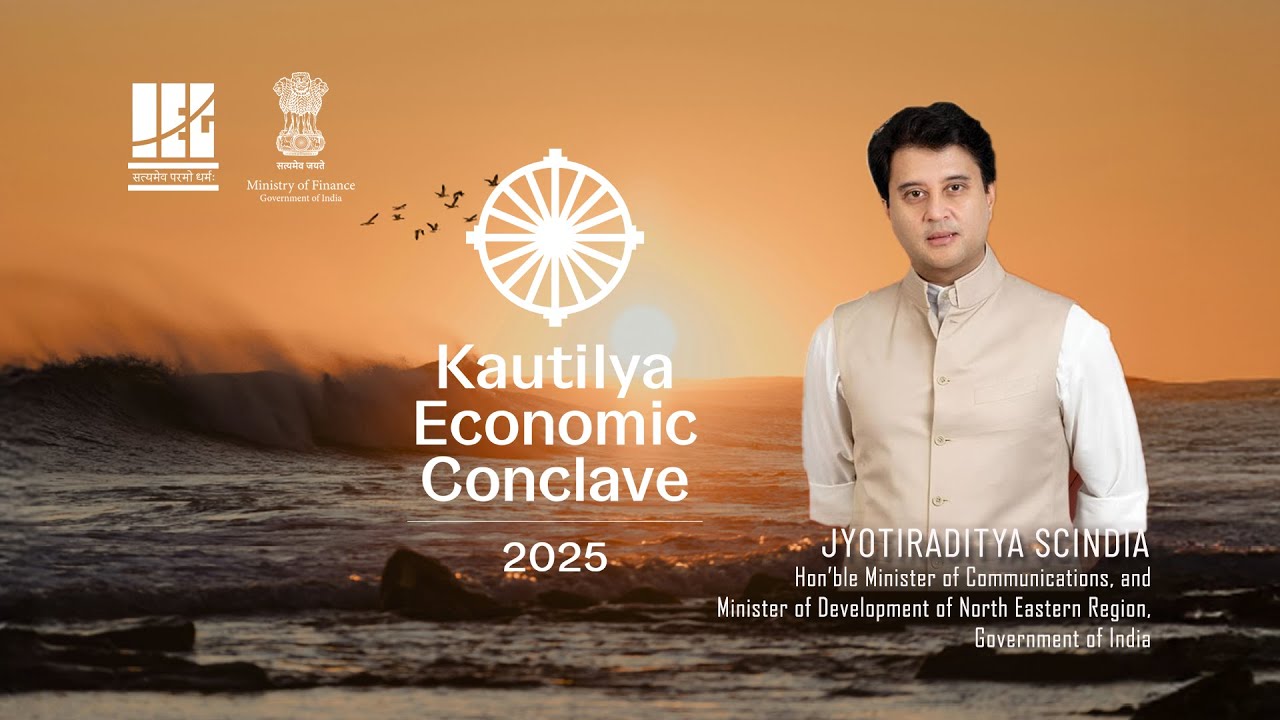
Shri Jyotiraditya Scindia’s Address at the Kautilya Economic Conclave 2025
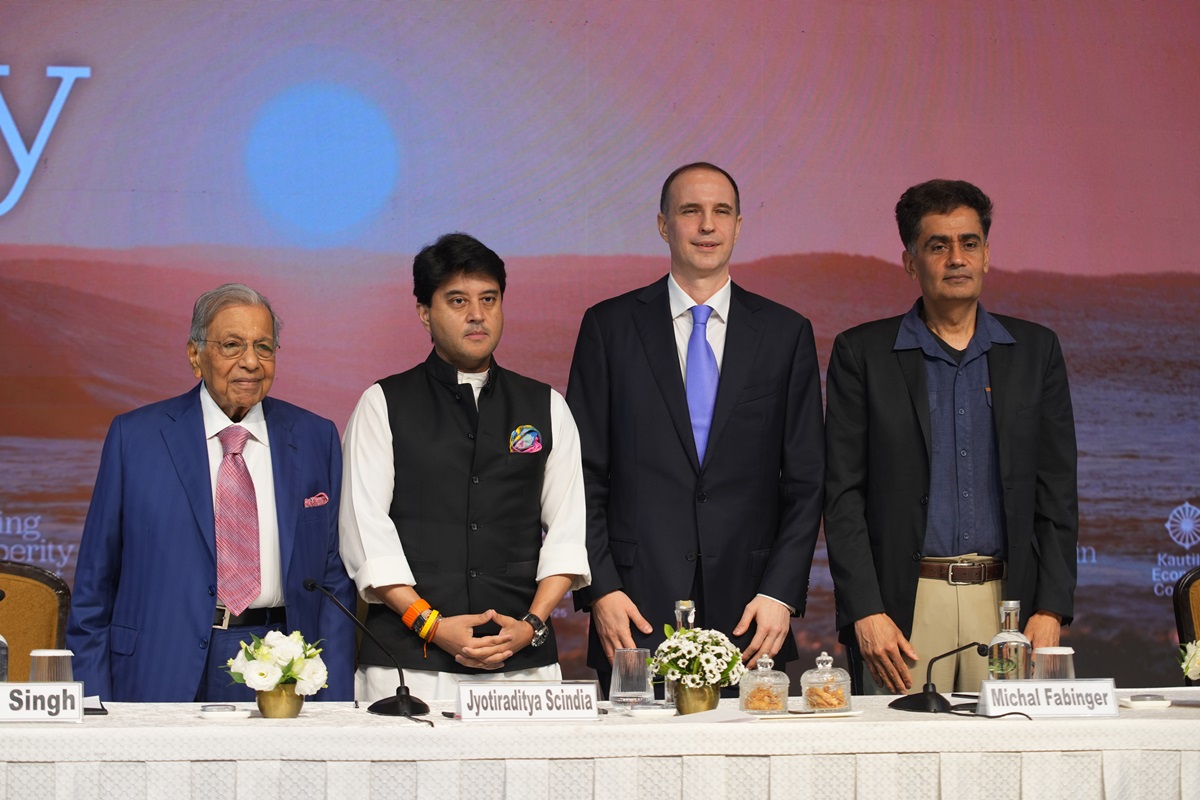
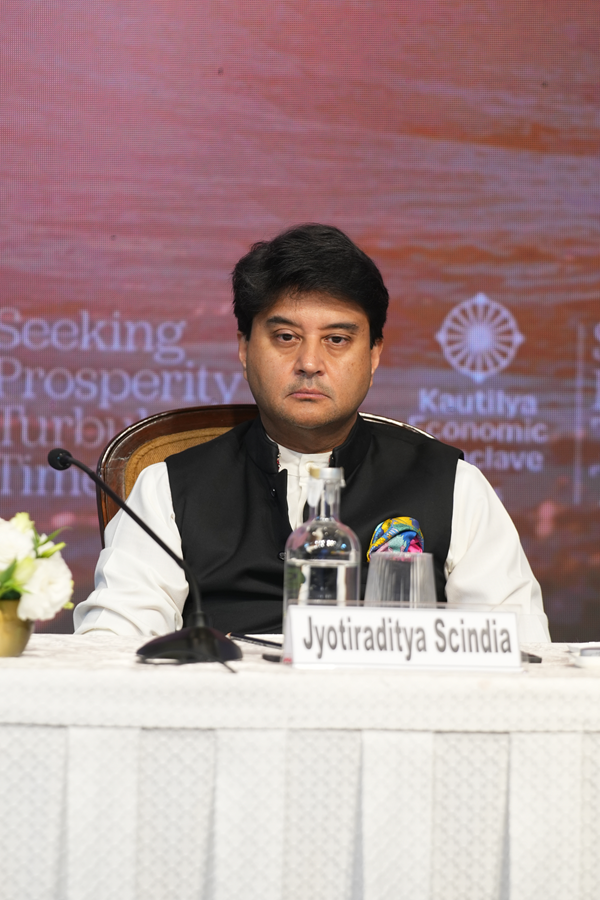
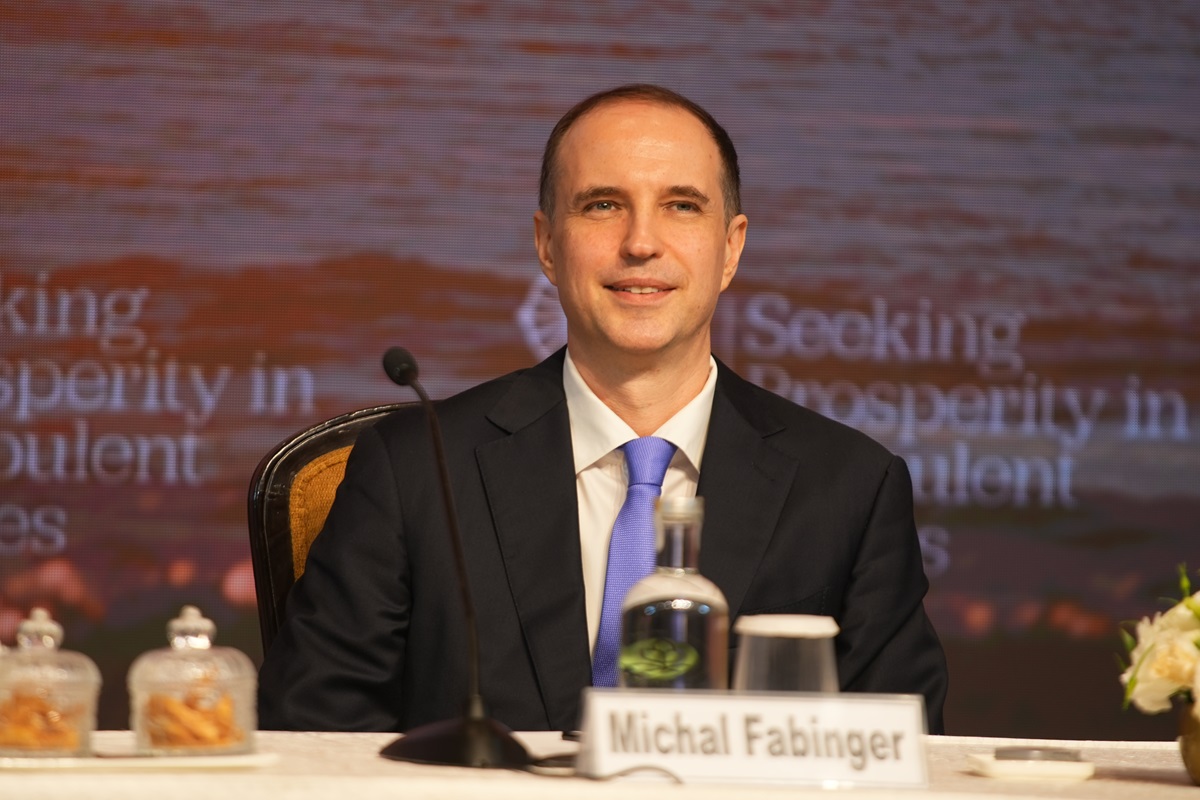
Union Minister Jyotiraditya Scindia delivered a powerful and forward-looking address at the Kautilya Economic Conclave 2025, reflecting on India’s transformation, resilience, and innovation in an era of global turbulence. Opening with gratitude to Shri N.K. Singh and other distinguished dignitaries, Scindia emphasized that the conclave’s theme — “Seeking Prosperity in Turbulent Times” — is not merely rhetorical but an urgent reflection of the age we live in.
He recalled the lessons from the COVID-19 pandemic — one of the most turbulent episodes in recent human history — when a microscopic virus exposed global fragility. Amid these disruptions, Scindia noted, India found direction instead of despair. Citing Kautilya’s wisdom — “Before you start some work, always ask yourself three questions: why am I doing it, what will be the results, and will I succeed?” — he said India answered each of these through decisive action, particularly in its semiconductor mission. Recognizing that semiconductors are the foundation of modern progress, India launched a national initiative with an outlay of ₹76,000 crore to establish fabs across the country and skill 85,000 workers. Within four years, investments in the sector exceeded ₹1.6 lakh crore. These “digital diamonds,” Scindia said, reflect India’s foresight and determination to shape its technological destiny.
The Minister emphasized that turbulence has become the rhythm of our times, not an anomaly. The world faces conflicts and wars threatening energy security, protectionism disrupting trade, climate shocks causing economic vulnerability, and inflation eroding global prosperity. Against this backdrop, he invoked Joseph Schumpeter’s concept of “creative destruction”, explaining that while turbulence dismantles old systems, it also gives birth to innovation and renewal. “Turbulence is not merely a disruptor — it is also a catalyst,” Scindia said, adding that India has emerged as that catalyst, growing at 7.8% in the first quarter of FY 2025–26 and becoming the fulcrum of the Global South.
He asserted that India today stands as a bridge between East and West, and North and South, embodying fairness, equity, and stability in a fragmented world. “India is not just another destination,” he declared. “India is the direction.” This, he said, is India’s message to the world — that prosperity in turbulent times lies in self-reliance, innovation, and confidence.
Illustrating India’s resilience, Scindia detailed the country’s revolution in digital infrastructure and connectivity. India now has 1.22 billion mobile subscribers and 944 million broadband users — a 15-fold increase in a decade. In less than two years, 5G has reached 99.8% of India’s districts. Through the Digital Public Infrastructure (DPI) and Unified Payments Interface (UPI), India now records 19 billion digital transactions monthly, amounting to $3 trillion annually. Remarkably, 46% of the world’s digital payments occur in India, making it a global benchmark for innovation-driven inclusion.
He highlighted Prime Minister Narendra Modi’s vision of Atmanirbhar Bharat, which seeks opportunities in challenges and focuses on self-reliance through indigenous innovation. A prime example is India’s indigenous 4G technology stack, developed jointly by CDOT, Tejas Networks, and TCS. This collaboration led to the creation of an entirely Indian telecommunications ecosystem, connecting over 92,000 towers from Kashmir to Kanyakumari and from Bharuch to Arunachal Pradesh. For the first time, India joined a global elite club — previously dominated by Sweden, Finland, South Korea, and China — of nations with their own telecom technology. Scindia added that these 4G towers will soon transition to 5G, making India self-sufficient in end-to-end digital connectivity.
The Minister underscored that India is a “digital-first nation”, with rapid growth in broadband penetration and mobile manufacturing, and now positioning itself as a global AI hub. Through the India AI Mission, the country is building large-scale computing infrastructure, supporting domestic foundational models, and empowering startups. Private players have already deployed 38,000 GPUs, investing nearly ₹20,000 crore, while national investments in AI infrastructure are projected to exceed $10 billion. Yet, Scindia stressed, India’s goal is not imitation but Atmanirbhar innovation — AI “designed for India, by India, in Indian languages, and for Indian priorities.”
He illustrated this vision with an example from his recent visit to Bengaluru, where an indigenous AI module — Bhashini — translated his speech live from English to Kannada, symbolizing the democratization of technology. Scindia also identified four key challenges in AI: sustainable scaling given power demands, reskilling human resources, regulatory adaptability, and ensuring ethical, inclusive innovation. India is addressing these through a whole-of-government approach, flexible ministry-level frameworks, and the creation of regulatory sandboxes to foster entrepreneurship. The upcoming Digital Consumer Charter, he added, will further strengthen digital trust and data protection.
Looking ahead, Scindia said India is poised to become one of the top five AI nations globally. With achievements such as being the world’s #1 in mobile data consumption, #2 in internet users and mobile manufacturing, #3 in startups, and #4 in renewable energy capacity, India’s ascent is undeniable. By 2027, he projected, India will be the world’s third-largest economy, and by 2038, the second-largest.
He concluded by asserting that the true power of a nation lies in harnessing both wealth and intellect. From Chanakya’s strategic foresight to Aryabhatta’s zero, India’s civilizational continuity of innovation endures. Today, that same spirit is propelling India into a future defined by self-reliance, technological leadership, and global stewardship. “India,” Scindia affirmed, “does not just survive turbulent times — she leads, she guides, and she inspires the world.”
Photographs
KEC 2025 VIDEO